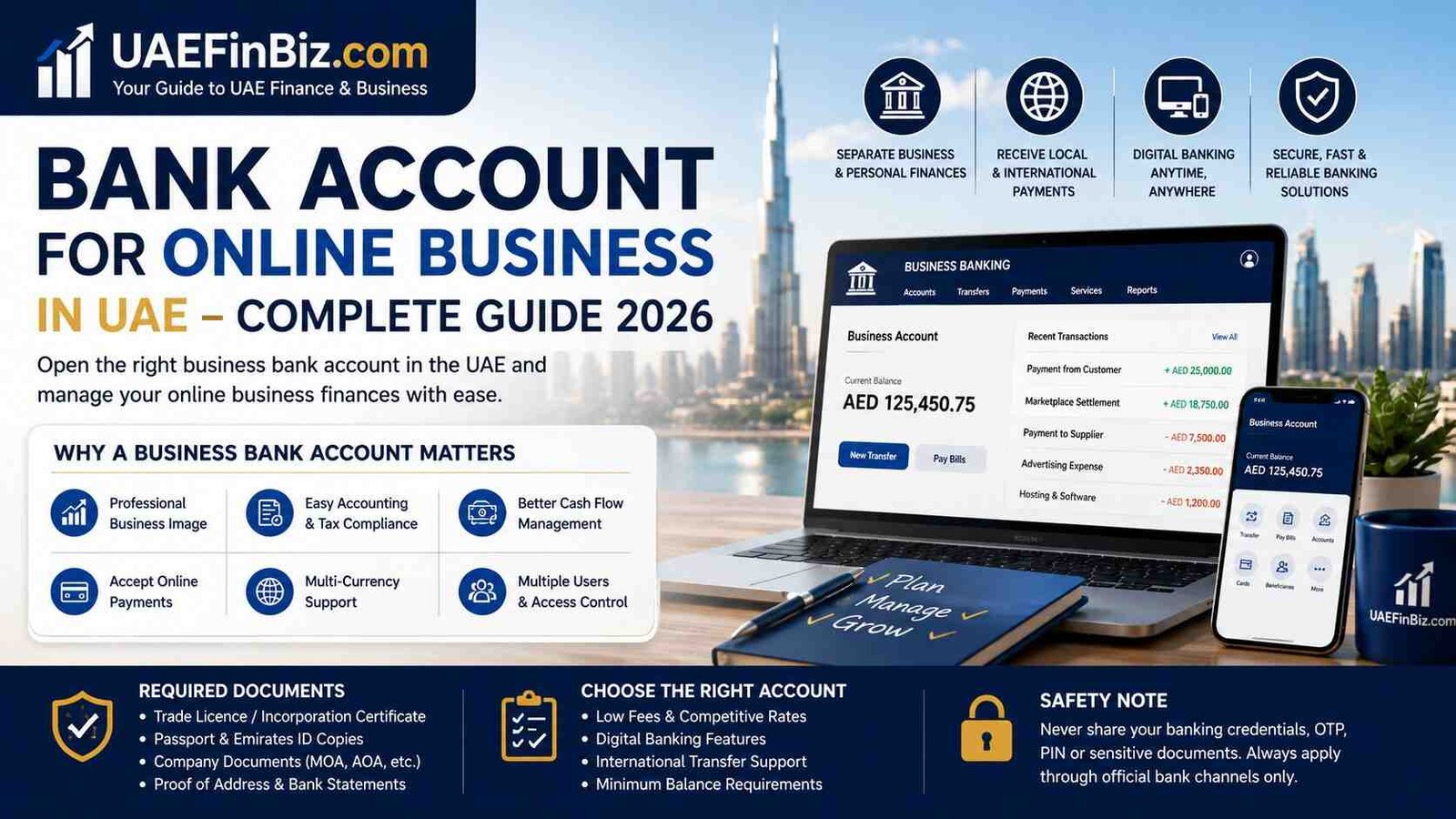
Bank Account for Online Business in UAE – Complete Guide 2026
Starting an online business in the UAE is easier than ever, but one financial decision deserves attention from the beginning: choosing the right bank account for online business. Whether you run an e-commerce store, digital agency, consultancy, online service, marketplace business, or another internet-based company, a dedicated business account can make payments, accounting, tax records, supplier transactions, and cash-flow management much easier.
The UAE government recognises business accounts as one of the standard banking options available to companies, while banks increasingly offer digital application and online business-banking services. The exact requirements, fees, minimum balances, and approval process depend on the bank and the legal structure of your business.
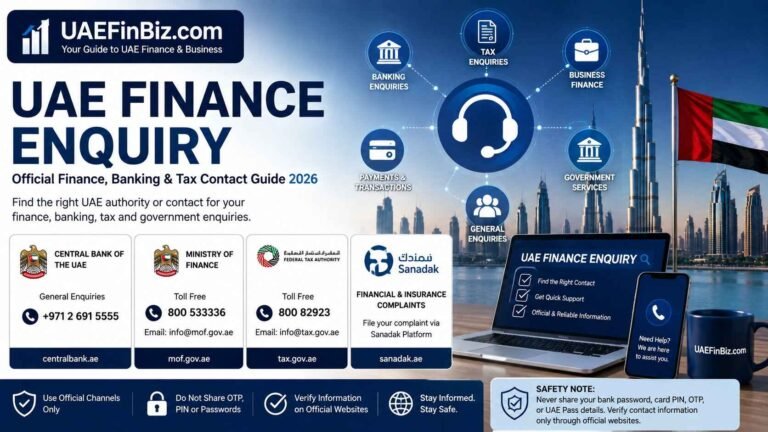
Safety Note: Never open a business bank account through an unofficial agent, social-media link, or unknown website. Verify the bank and application page before submitting your Emirates ID, passport, trade licence, banking information, or other sensitive documents. For UAE banking regulations and licensed financial institutions, check the Central Bank of the UAE official website.
What Is a Bank Account for an Online Business?
A bank account for an online business is a business or corporate account used to receive and make payments for commercial activities conducted partly or entirely online.
For example, an online business may use its account to:
- Receive customer payments
- Pay suppliers
- Pay advertising platforms
- Receive marketplace settlements
- Transfer money to business partners
- Pay employees
- Handle subscriptions and software expenses
- Pay government and business expenses
- Manage international transactions
- Maintain proper financial records
The fact that a company operates online does not normally mean that it needs a special type of “online business bank account.” In practice, you usually need an appropriate business bank account, while the bank’s digital banking platform allows you to manage that account online.
Can You Open a Business Bank Account Online in the UAE?
Yes, some UAE banks allow eligible businesses to start or complete business-account applications digitally.
The UAE Government states that many banks allow customers to apply through a bank website or mobile application, while self-employed individuals and businesses may need to provide business documents such as a trade licence and company documents.
However, online application does not necessarily mean automatic approval.
Banks still need to verify the business, its owners, authorised signatories, business activity, source of funds, expected transactions, and other information required by their compliance procedures.
For example, Emirates NBD currently offers digital business-account applications for eligible UAE businesses and requires documents including a valid trade licence or certificate of incorporation, identity documents, constitutional documents, and other supporting information.
Do You Need a Business Licence Before Opening the Account?
For a normal UAE company business account, having a properly established business is generally an important starting point.
The UAE Government explains that establishing a business involves selecting the business activity, choosing the legal form, obtaining the necessary approvals, and getting the business licence.
A bank will normally want to understand:
- What your business does
- Where it operates
- Who owns it
- Who controls the account
- Where business money comes from
- Expected transaction activity
- Which countries you will receive or send money to
This is why getting the correct business licence and maintaining accurate company information can make the banking process more straightforward.
What Documents Are Usually Required?
The exact document list varies between banks and business structures, but common requirements can include:
- Valid UAE trade or commercial licence
- Certificate of incorporation, where applicable
- Passport copies of owners
- Emirates IDs of relevant owners or authorised signatories
- Memorandum of Association
- Articles of Association
- Board resolution, where applicable
- Power of Attorney, where applicable
- Proof of business address
- Company bank statement, if the business already operates
- Personal or partner bank statements in certain cases
- Business plan or website information
- Information about expected business transactions
- Details about suppliers and customers
For example, Emirates NBD’s current digital business-account requirements include a valid trade licence or certificate of incorporation, passport and Emirates ID copies for relevant shareholders and authorised signatories, constitutional documents, and bank-statement documentation.
A bank can request additional information depending on the nature and risk profile of the business.
What If Your Business Is New?
New businesses sometimes have fewer financial records because they have not started trading yet.
That does not necessarily prevent a business from applying for an account, but the bank may want additional information to understand the business model.
You may be asked about:
- Expected monthly revenue
- Expected transaction volume
- Initial capital
- Business model
- Target customers
- Main suppliers
- Countries involved in transactions
- Source of initial funds
- Website or online store
- Contracts or invoices
- Expected payment methods
For a newly launched online business, having a clear website, valid business licence, professional email address, business plan, and realistic transaction expectations can help demonstrate that the company is a genuine operating business.
Can Freelancers Open a Business Bank Account?
This depends on the person’s legal structure, licence, bank policy, and the nature of the activity.
A freelancer operating under an appropriate UAE permit or licence may have different banking options from an LLC, sole establishment, or free-zone company.
Do not assume that every freelancer automatically qualifies for the same corporate banking products.
The bank may assess whether the applicant is:
- An individual
- A freelancer
- A sole proprietor
- A sole establishment
- An LLC
- A free-zone company
- Another recognised legal entity
The account should match the legal structure under which the business operates.
Personal Account vs Business Account
One of the most important decisions for an online entrepreneur is understanding the difference between a personal account and a business account.
Personal Bank Account
A personal account is designed primarily for personal financial activity such as:
- Salary
- Personal spending
- Household expenses
- Personal savings
- Individual transfers
Business Bank Account
A business account is designed for commercial transactions such as:
- Customer receipts
- Supplier payments
- Business expenses
- Payroll
- Tax-related payments
- Business transfers
- Corporate financial management
Keeping business and personal transactions separate can make bookkeeping and financial reporting much easier.
It also gives you a clearer picture of the actual performance of the business.
Why Online Businesses Should Separate Their Finances
Imagine an online store receiving AED 80,000 in customer payments while simultaneously using the same account for rent, groceries, personal subscriptions, travel, and other personal spending.
At the end of the year, determining the actual business revenue and expenses becomes unnecessarily difficult.
A dedicated business account creates a cleaner financial trail.
It can help with:
Accounting: Business income and expenses are easier to identify.
Cash flow: You can see how much money belongs to the business.
Tax records: Proper records can make tax compliance easier.
Professional image: Customers and suppliers may expect payments to be made through a business account.
Growth: A clear financial history can become useful when seeking business finance or other banking services.
What Type of Bank Account Is Best for an Online Business?
There is no single best account for every online business.
The right choice depends on the company’s size, transaction volume, currencies, payment methods, and banking requirements.
Digital-Focused Business Account
This can be useful for entrepreneurs who want to manage most banking activity through an app or online platform.
Look for:
- Online onboarding
- Mobile banking
- Business internet banking
- Digital statements
- Online transfers
- Multiple-user access
- Payment approvals
- Transaction alerts
Traditional Business Current Account
A traditional business current account may be more suitable for companies that need broader banking services.
These may include:
- Cheque facilities
- Cash deposits
- Trade finance
- Relationship management
- Business loans
- Working-capital facilities
- Payroll services
- International banking
Multi-Currency Business Account
If your online business sells internationally, consider whether the bank supports the currencies and international transactions your business actually needs.
For example, an online business serving customers in the UAE, United States, United Kingdom, and Europe may have different foreign-exchange requirements from a company serving only UAE customers.
Compare:
- Supported currencies
- Exchange rates
- International transfer fees
- Receiving fees
- Correspondent-bank charges
- Settlement time
What Should You Compare Before Choosing a Bank?
Don’t select a business account solely because the application is fast.
Compare the overall cost and functionality.
Monthly or Maintenance Fees
Some accounts have monthly charges while others may waive fees if certain requirements are met.
Minimum Balance
Some business accounts require a minimum average balance.
For example, current Emirates NBD business packages have different minimum-balance and fee structures depending on the package.
Always check the current bank tariff rather than relying on an old blog post.
Transaction Charges
An online business may make dozens or hundreds of payments each month.
Check charges for:
- Local transfers
- International transfers
- Incoming payments
- Cash deposits
- Cheques
- Manager’s cheques
- Online transfers
International Transfers
If your business works with overseas clients or suppliers, international transfer costs can become significant.
Online Banking
Check whether the bank offers:
- Business mobile banking
- Desktop banking
- Multiple users
- Approval workflows
- Bulk payments
- Statements
- Transaction notifications
- Payroll functionality
Customer Support
A business account problem can affect sales, supplier payments, and payroll, so accessible business support can be valuable.
Online Business Bank Account for E-Commerce
E-commerce businesses often have more complicated payment flows than traditional businesses.
For example, money may move through:
Customer → Payment Gateway → Settlement → Business Bank Account
or:
Customer → Marketplace → Marketplace Fees → Business Settlement → Bank Account
Your bank should be able to support the type and volume of transactions generated by your business.
Before opening an account, understand how your payment gateway or marketplace settles money and whether the bank has requirements for those transactions.
Online Business Bank Account for Digital Agencies
Digital agencies may receive payments from clients locally and internationally.
A suitable business account may need:
- International incoming payments
- AED transfers
- Foreign-currency support
- Online banking
- Multiple authorised users
- Supplier payments
- Payroll
- Business debit cards
If the agency pays freelancers or contractors overseas, international transfer costs should also be considered.
Online Business Bank Account for Freelancers and Consultants
Consultants, designers, developers, marketers, and other online professionals should consider an account that supports the way they actually receive money.
For example, if most clients pay by bank transfer, an account with convenient local and international receiving capabilities may be more important than a large branch network.
If the business is very small, minimizing unnecessary account fees can also matter.
Online Business Bank Account for Dropshipping Businesses
Dropshipping businesses can have unusual transaction patterns because customers may pay the UAE business while suppliers are located overseas.
This means the bank may want to understand:
- The website
- Products being sold
- Supplier locations
- Customer markets
- Payment gateway
- Expected transaction volume
- International payments
A clear and transparent business model is important when completing a bank application.
Never hide the actual nature of your business just to make an application appear simpler.
Does an Online Business Need a Payment Gateway?
Not necessarily.
A payment gateway is a separate service that allows businesses to accept certain electronic payments, particularly card or online checkout payments.
A business bank account, on the other hand, is where business funds can be held and managed.
Depending on the business model, you may use:
Business bank account + payment gateway + online store
or:
Business bank account + marketplace
or:
Business bank account + direct bank transfers
The best setup depends on how customers pay you.
IBAN and Online Business Payments
An IBAN is important for receiving and making electronic bank payments.
The UAE Government states that IBAN is mandatory for electronic payments and receipts within and outside the UAE, with certain exclusions such as credit-card payments.
Once your business account is opened, your bank provides the relevant account details and IBAN.
Use the correct business account information when sending invoices to customers.
Can an Online Business Receive International Payments?
Many UAE business accounts can support international payments, but the exact currencies, fees, limits, documentation requirements, and processing times depend on the bank.
Before choosing an account, ask:
- Can I receive international transfers?
- Which currencies are supported?
- What are the incoming transfer charges?
- What foreign-exchange rate is used?
- Are intermediary-bank fees possible?
- Are there transaction limits?
- What documents may be requested for larger transactions?
This is especially important for online businesses selling services or products internationally.
Can You Apply for a Business Account Completely Online?
Some banks provide digital onboarding, but the exact process varies.
The UAE Government confirms that many banks allow online applications, while banks may still require verification and supporting documents.
For example, Emirates NBD currently describes a digital application process in which applicants enter business information, provide financial and shareholder details, select banking services, complete verification, and wait for assessment before activation.
So the better expectation is:
Apply online → submit documents → verification → compliance assessment → approval → account activation
rather than assuming that an online application guarantees instant account opening.
Why Can a Business Bank Account Application Be Rejected?
Banks do not approve every application automatically.
An application can require additional review because of factors such as:
- Incomplete documentation
- Unclear business activity
- Ownership structure
- Unclear source of funds
- Unusual expected transactions
- High-risk jurisdictions
- Inconsistent information
- Expired documents
- Business activity that requires additional regulatory approval
- Bank-specific eligibility criteria
A rejection from one bank does not necessarily mean that the business cannot obtain an account elsewhere.
The correct response is to understand the bank’s requirements and ensure the business documentation is accurate.
How to Prepare Before Applying
Before starting the application, prepare a simple business-information file containing:
Company details: Legal name, licence number and business activity.
Ownership: Names and identification documents of shareholders and beneficial owners.
Management: Details of authorised signatories.
Business model: Explain how the company makes money.
Customers: Identify the main customer markets.
Suppliers: Identify major supplier locations.
Expected transactions: Estimate monthly incoming and outgoing payments.
Website: Keep your online store or company website active and accurate.
Financial information: Prepare available bank statements and supporting financial records.
This can make the application process more organised.
What About Free-Zone Businesses?
Free-zone companies can also require business banking, but requirements vary according to the company structure and bank.
The bank may examine:
- Free-zone licence
- Certificate of incorporation
- Shareholder information
- Company documents
- Registered address
- Business activity
- Source of funds
- Expected transactions
Do not assume that having a free-zone licence automatically guarantees approval.
Banking is a separate process from company formation.
What About Mainland Businesses?
Mainland businesses can also open business bank accounts after establishing the company and obtaining the relevant licence.
The UAE Government’s current business guidance specifically includes opening a bank account among the key steps involved in operating a mainland business.
The exact banking requirements depend on the bank and the business structure.
Business Account and UAE Corporate Tax
A business bank account does not itself determine your Corporate Tax liability.
However, maintaining clear business financial records can be extremely useful for accounting and tax compliance.
The UAE’s Corporate Tax framework applies according to the applicable rules, and businesses should maintain appropriate financial records and understand their filing obligations.
For tax-specific questions, use the Federal Tax Authority official website rather than relying on unofficial tax calculators or social-media advice.
Business Bank Account and Accounting
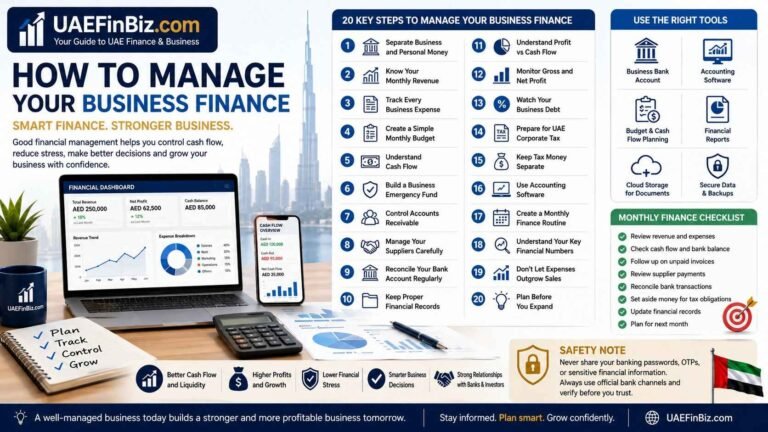
A dedicated account can simplify accounting because transactions are easier to categorise.
For example:
Income
Customer payments, service revenue, marketplace settlements.
Operating expenses
Software, advertising, hosting, office costs, professional services.
Supplier payments
Inventory, logistics, contractors and vendors.
Financial expenses
Bank charges and financing costs.
This separation can make monthly financial reporting much cleaner.
How Much Does a UAE Business Bank Account Cost?
There is no single UAE-wide price.
Costs depend on the bank and account package.
Potential charges can include:
- Account maintenance fee
- Minimum-balance shortfall fee
- Local transfer fee
- International transfer fee
- Cash deposit fee
- Cheque-related charges
- Debit-card charges
- Foreign-exchange costs
- Additional service fees
For example, current Emirates NBD business packages have different monthly fees and minimum-balance requirements, demonstrating why businesses should compare the specific package rather than assume that all UAE business accounts have the same cost.
Best Strategy for a Small Online Business
If you are starting a small online business, don’t automatically choose the most expensive corporate banking package.
Instead, estimate your actual requirements.
Ask:
- How much money will enter the account every month?
- How many payments will I make?
- Will customers pay from outside the UAE?
- Do I need multiple currencies?
- Do I need employees and payroll?
- Do I need a business debit card?
- Will I need financing later?
- What minimum balance can I comfortably maintain?
Then compare accounts based on total cost and functionality.
Common Mistakes to Avoid
Using a Personal Account for Business Without Checking the Rules
A personal account may not be designed for commercial activity. Check the bank’s terms and use an appropriate account for your business structure.
Choosing Only on the Basis of “No Minimum Balance”
A zero-minimum-balance account can be attractive, but transaction fees and other charges may still matter.
Ignoring International Fees
For an international online business, foreign-exchange and transfer charges can become a significant expense.
Giving Incorrect Business Information
The business activity, website, expected transactions and source of funds should be described accurately.
Applying Through Unofficial Agents
Always verify the bank’s official website and application channel.
Forgetting About Accounting
A business account is not a replacement for proper bookkeeping.
Quick Checklist for Opening a UAE Online Business Bank Account
Before applying, make sure you have:
- Valid UAE business licence
- Passport copies
- Emirates IDs where required
- Company incorporation documents
- MOA/AOA where applicable
- Board resolution or POA where applicable
- Proof of business address
- Bank statements where required
- Active website or online store
- Clear business description
- Expected transaction information
- Customer and supplier information
- Source-of-funds information
- Contact details
The final document list can differ by bank and company structure.
Frequently Asked Questions
What is the best bank account for an online business in the UAE?
There is no universally best account. The right choice depends on your business structure, transaction volume, international payments, currencies, minimum-balance capacity, fees, and required digital banking features.
Can I open a UAE business bank account online?
Yes, some UAE banks offer digital business-account applications. However, online application does not guarantee approval, and the bank may still require document verification and compliance checks.
Can I open a business bank account without a trade licence?
For a standard UAE company business account, a valid business licence or equivalent company documentation is commonly required. Requirements vary depending on the legal structure and bank.
What documents do I need for an online business bank account?
Common documents include a trade licence, incorporation documents, passports, Emirates IDs of relevant individuals, constitutional documents, proof of address and sometimes bank statements or additional business information.
Can an e-commerce business open a UAE bank account?
Yes, an e-commerce business can apply for an appropriate business account, provided it meets the bank’s eligibility and compliance requirements. The bank may ask for information about the website, business activity, payment methods, suppliers, customers and expected transactions.
Can a freelancer have a UAE business bank account?
Depending on the freelancer’s licence or permit and legal structure, business banking options may be available. The bank will determine eligibility based on its requirements.
Is a business bank account required for an online business?
The exact requirement depends on the business structure and applicable rules, but using a dedicated business account is generally a sensible way to separate commercial and personal finances and maintain clearer records.
Can I receive international payments into a UAE business account?
Many business accounts support international payments, but supported currencies, fees, limits and documentation requirements vary. Check these details with the bank before opening the account.
How long does it take to open a UAE business bank account?
There is no universal processing time. Some digital applications can be submitted quickly, but approval depends on document verification and the bank’s assessment. The UAE Government notes that account activation can take from hours to several days depending on the bank.
Final Thoughts
Choosing a bank account for an online business should be treated as a business decision rather than simply a banking formality. A good account can make customer payments, supplier transfers, international transactions, accounting, cash-flow management, and day-to-day financial administration considerably easier.
Before applying, make sure your UAE business licence and company documents are in order, understand your expected transaction activity, compare fees and minimum-balance requirements, and choose digital banking features that match the way your business operates.
For entrepreneurs building an online business in the UAE, UAEFinBiz.com provides practical finance and business information to help make financial decisions clearer. Always verify account requirements, fees, eligibility and regulatory information directly with the relevant bank or UAE authority before applying.