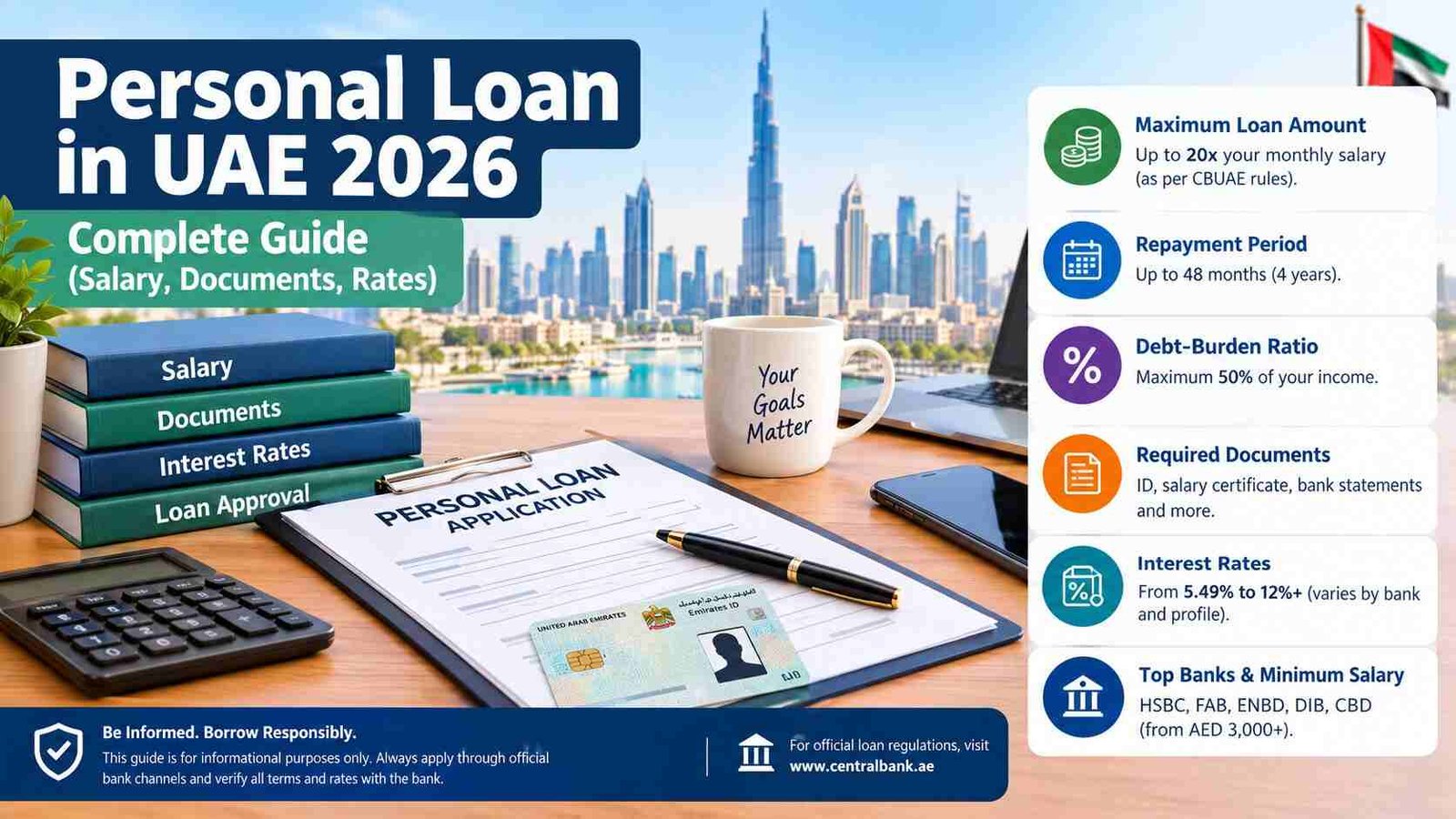
Personal Loan in UAE — Complete Guide (Salary, Documents, Rates)
You need cash. Maybe it’s a medical bill, a school fee, a wedding, or you’re just tired of living paycheck to paycheck. You’ve heard ads promising “instant approval” and “zero documents.” But you also know someone who got buried in debt because they didn’t understand the rules.
Here’s the truth: getting a personal loan in the UAE is straightforward if you understand how banks actually assess you. The Central Bank of the UAE (CBUAE) sets clear rules that protect both you and the lender . This guide breaks down exactly what you need to know — salary requirements, documents, interest rates, and the debt-burden ratio that makes or breaks your application.
Safety Note: UAEfinbiz is an informational guide only and does not have access to your bank account or personal information. Never share your Emirates ID, salary certificate, bank statements, or OTP with any third-party website or individual claiming to process loans. Always apply directly through official bank channels or licensed financial institutions. Verify all terms, rates, and fees directly with the bank before signing any agreement. For verified information on loan regulations, visit the official Central Bank of the UAE website at www.centralbank.ae .
What Is a Personal Loan in the UAE?
A personal loan is money you borrow from a bank or finance company, repaid over a fixed period with interest . It’s secured by your salary, end-of-service gratuity, or any regular verifiable income . Unlike a mortgage or car loan, you don’t need collateral — the bank trusts your income stream.
The CBUAE regulates these loans under Regulation No. 29/2011 . This regulation sets the maximum you can borrow, how long you can take to repay, and what percentage of your income can go toward debt. Understanding these rules is the difference between a smooth approval and a painful rejection.
The Four Rules That Decide Everything
Rule 1: Maximum Loan Amount — 20x Your Salary
The CBUAE caps personal loans at 20 times your monthly salary or total regular income . This is a hard ceiling, not a target.
What this looks like:
- AED 10,000 salary → Maximum AED 200,000 loan
- AED 5,000 salary → Maximum AED 100,000 loan
- AED 20,000 salary → Maximum AED 400,000 loan
Banks may offer less based on your credit profile, employer category, and existing debts. The 20x rule is the legal limit, not a guarantee.
Rule 2: Repayment Period — Maximum 48 Months
You have up to 48 months (4 years) to repay . Some banks offer shorter terms, and a few may extend for Armed Forces personnel . The shorter your term, the higher your monthly installment but the less interest you pay overall.
Rule 3: Debt-Burden Ratio (DBR) — Maximum 50%
This is the rule that catches most people. Your total monthly debt payments cannot exceed 50% of your gross monthly income .
What counts toward DBR:
- Personal loan installments
- Credit card minimum payments
- Car loan installments
- Mortgage payments
Example: If you earn AED 10,000/month, your total debt payments cannot exceed AED 5,000/month. If you already pay AED 2,000 on a car loan and AED 500 on credit cards, you only have AED 2,500 available for a new personal loan.
Rule 4: Minimum Salary — Banks Set Their Own
The CBUAE removed the mandatory AED 5,000 minimum salary requirement in late 2025 . But individual banks still set their own thresholds.
What banks currently require:
| Bank | Minimum Salary (AED) |
|---|---|
| HSBC | 7,500 (approved companies) / 12,500 (others) |
| FAB | 7,000 |
| Emirates NBD | 6,000 (salary transfer) / 10,000 (without) |
| DIB | 3,000 |
| CBD | 10,000 |
If you earn below AED 5,000: You can still apply, but fewer banks will consider you. Focus on banks with lower thresholds like DIB, or consider digital lending apps that assess overall affordability rather than just salary .
How Banks Assess Your Application
Banks don’t just look at your salary. They evaluate:
Your AECB Score: The Al Etihad Credit Bureau tracks your repayment history. A score above 700 improves your chances. Missed payments stay on your record for years .
Your Employer: Banks categorize employers by stability. Government, semi-government, and multinational companies get the best rates. Free zone companies and SMEs face stricter scrutiny.
Your Existing Liabilities: Every loan and credit card you have reduces your borrowing capacity. Banks see your full debt picture through AECB.
Your Job Stability: Most banks want at least 6-12 months with your current employer. Frequent job changes raise red flags.
Documents You Need
The exact list varies by bank, but most require:
For Salaried Employees:
- Emirates ID (front and back)
- Passport copy with valid visa page
- Salary certificate (original, addressed to the bank, dated within 30 days)
- 3-6 months of bank statements (showing salary credits)
- Labor contract or employment letter
- AECB consent form
For Self-Employed:
- Trade license
- Memorandum of Association
- 6-12 months of bank statements
- Audited financials (some banks)
- Emirates ID and passport
Pro tip: Some digital lenders now accept UAE Pass and digital salary certificates, eliminating paper entirely. Banks like Mashreq and ADCB offer paperless applications through their apps.
Interest Rates — What You’ll Actually Pay
Rates vary by bank, your salary, employer, and AECB score. The CBUAE requires banks to quote rates on a reducing balance basis and disclose the APR .
Current indicative rates:
Important: The advertised rate is never guaranteed. Your final rate depends on your individual profile. A 7% rate might become 12% if your AECB score is average.
Fees You’ll Pay
Processing/Arrangement Fee: Typically 1% of the loan amount, minimum AED 500, maximum AED 2,500 (plus VAT) .
Early Settlement Fee: If you pay off your loan early, banks charge 1.05% of the outstanding balance or AED 10,500, whichever is lower . This is capped by CBUAE regulation .
Late Payment Fee: Varies by bank, but typically a fixed amount plus interest.
Insurance: Some banks require credit life insurance. HSBC, for example, does not require it .
How to Apply — Step by Step
Step 1: Check Your AECB Score
Before applying anywhere, request your free credit report from Al Etihad Credit Bureau. Know your score and fix any errors.
Step 2: Calculate Your DBR
Add up all monthly debt payments. Divide by your gross salary. If it’s above 40%, you’re risky. Above 50%, you’re likely rejected.
Step 3: Compare Banks
Don’t apply to 10 banks. Each application hits your AECB report. Apply to 2-3 banks that match your profile.
Step 4: Prepare Documents
Get your salary certificate, bank statements, and Emirates ID ready. Digital banks accept UAE Pass uploads.
Step 5: Apply Directly
Apply through the bank’s official app, website, or branch. Never through a third-party agent who asks for upfront fees.
Step 6: Review the Offer
Check the APR, total repayment amount, fees, and early settlement terms. Don’t sign until you understand every number.
Common Mistakes That Get You Rejected
Applying to too many banks at once: Each application triggers a credit inquiry. Multiple inquiries in a short period signal desperation .
Ignoring your existing DBR: If you already have a car loan and credit cards, you may not qualify for as much as you think.
Using temporary income: Nafis payments and similar incentives cannot be counted as guaranteed income for loan eligibility . Banks assess only stable, verifiable salary.
Not checking your AECB report: Errors on your credit report can cause rejection. Fix them before applying.
Applying with a new employer: Most banks want 6-12 months of job stability. Wait if you’ve just switched jobs.
What is the maximum personal loan amount in UAE?
The CBUAE caps personal loans at 20 times your monthly salary or regular income. If you earn AED 10,000, the maximum is AED 200,000. Banks may offer less based on your credit profile and existing debts.
What is the minimum salary for a personal loan in UAE?
The CBUAE removed the mandatory AED 5,000 minimum in late 2025. However, individual banks set their own thresholds. HSBC requires AED 7,500-12,500. DIB accepts salaries from AED 3,000. Check with each bank directly.
What is the debt-burden ratio (DBR) and why does it matter?
DBR is your total monthly debt payments divided by your gross monthly income. The CBUAE caps it at 50%. If your DBR exceeds 50%, banks cannot approve your loan. Keep it below 40% for the best chances.
How long can I take to repay a personal loan in UAE?
Maximum 48 months (4 years) as per CBUAE regulation. Some banks offer shorter terms. Armed Forces personnel may qualify for longer periods.
Can I get a personal loan without salary transfer?
Yes, but fewer banks offer this. CBD’s Quick Loan and Mashreq NEO Credit don’t require salary transfer. Emirates NBD allows it but with a higher minimum salary (AED 10,000 vs AED 6,000 with transfer). Expect stricter approval criteria.
What documents do I need for a personal loan in UAE?
Typically: Emirates ID, passport with visa, salary certificate, 3-6 months bank statements, labor contract, and AECB consent form. Self-employed applicants need trade license, MOA, and financial statements.
How much does it cost to settle a personal loan early?
Early settlement fee is capped at 1.05% of outstanding balance or AED 10,500, whichever is lower. This is regulated by the CBUAE.
Why was my personal loan application rejected?
Common reasons: DBR above 50%, low AECB score, insufficient job stability, applying to too many banks, or income that doesn’t meet the bank’s minimum threshold. Check your AECB report and reduce existing debts before reapplying.