
Business Finance UAE: A Complete Guide to Managing, Funding and Growing a Business
Running a business in the UAE is no longer just about having a good product, finding customers, and keeping sales moving. Finance has become one of the most important parts of building a sustainable company. Whether you are starting a small business in Dubai, managing an established company in Abu Dhabi, operating from a free zone, or expanding across the Emirates, understanding business finance can make the difference between healthy growth and constant cash-flow pressure.
Business finance UAE covers much more than business loans. It includes working capital, business bank accounts, cash-flow management, accounting, business credit, trade finance, corporate tax, VAT, financing options, investment decisions, financial planning, and the technology used to manage company finances.
For UAE entrepreneurs, the biggest challenge is often not making money but managing it properly. A profitable company can still struggle if customers pay late, expenses arrive before revenue, inventory absorbs too much cash, or the business takes on financing that does not match its ability to repay.
Safety Note: Financial rules, tax requirements, financing terms, and eligibility conditions can change. Before making a tax, borrowing, investment, or business-finance decision, verify the latest information through official UAE authorities and your bank or licensed financial institution. For UAE Corporate Tax information, use the UAE Ministry of Finance official Corporate Tax page and the Federal Tax Authority official Corporate Tax information. Never share banking passwords, PINs, card security codes, or OTPs with anyone claiming to arrange business finance.
What Is Business Finance in the UAE?
Business finance refers to the way a company obtains, manages, spends, and invests money to operate and grow.
For a UAE business, this can include the money needed to:
- Launch a new company
- Pay employees and suppliers
- Purchase inventory
- Rent an office, warehouse, or shop
- Buy equipment and vehicles
- Manage daily operating expenses
- Fund expansion
- Import or export goods
- Invest in technology
- Handle temporary cash-flow shortages
- Acquire another business
- Build long-term financial reserves
The important point is that business finance is not simply about finding money when the company needs it. Good financial management starts before the need becomes urgent.
A business owner who understands monthly cash flow, outstanding invoices, upcoming expenses, financing costs, and available reserves can make decisions with much greater confidence.
Why Business Finance Matters for UAE Companies
The UAE has a highly developed banking and financial-services sector, but access to finance does not automatically mean that every business should borrow.
A company needs to understand why it requires funding, how much it actually needs, how long it will need the money, and how repayment will affect future cash flow.
For example, imagine a trading company receives a large order from a customer. The order could be profitable, but the company may need to pay its supplier several weeks before receiving payment from the customer.
The business may therefore have a temporary working-capital requirement.
This is different from a company borrowing money to cover permanent losses.
Understanding this difference is one of the foundations of responsible business finance.
Main Types of Business Finance in the UAE
There is no single financing solution that works for every UAE company. The appropriate option depends on the company’s size, industry, cash flow, assets, credit profile, business history, and purpose of borrowing.
Business Loans
Traditional business loans can provide companies with a lump sum that is repaid over an agreed period.
Businesses may use financing for expansion, equipment, working capital, premises, or other approved purposes.
Before accepting a business loan, the company should look beyond the advertised interest rate. The total cost can also depend on processing fees, early-settlement conditions, insurance requirements, collateral, repayment structure, and other charges.
The monthly payment should also be considered alongside realistic business cash flow.
Working Capital Finance
Working capital finance is designed around the day-to-day funding requirements of a business.
A company may have strong sales but still experience a cash shortage because:
- Customers pay after 30, 60, or 90 days
- Suppliers require advance payments
- Inventory must be purchased before sales occur
- Salaries and rent are due every month
- Import costs have to be paid before goods are sold
Working capital financing can help bridge timing gaps, but it should not become a permanent solution for a business that consistently spends more than it earns.
Business Credit Cards
Business credit cards can be useful for controlled company expenses, subscriptions, travel, online services, and short-term purchases.
They can also make expense tracking easier when employees use company-issued cards.
However, credit cards should be managed carefully. Carrying balances for long periods can make financing significantly more expensive than expected.
Trade Finance
Trade finance is particularly relevant to UAE businesses involved in importing, exporting, wholesale, distribution, and international trade.
Depending on the transaction and bank, trade-finance solutions can support activities such as purchasing goods, documentary transactions, letters of credit, guarantees, and import or export requirements.
The right structure depends heavily on the transaction itself, the counterparties involved, and the company’s banking relationship.
Asset and Equipment Finance
Businesses sometimes need expensive equipment without wanting to use all their available cash.
Asset finance can be relevant for machinery, vehicles, technology infrastructure, commercial equipment, and other productive assets.
The important question is whether the asset will generate enough economic value to justify its financing cost.
Business Finance for SMEs in the UAE
Small and medium-sized businesses form an important part of the UAE’s commercial landscape. For an SME, financial discipline can be particularly important because the company may have fewer reserves than a large corporation.
A small business should maintain a clear view of:
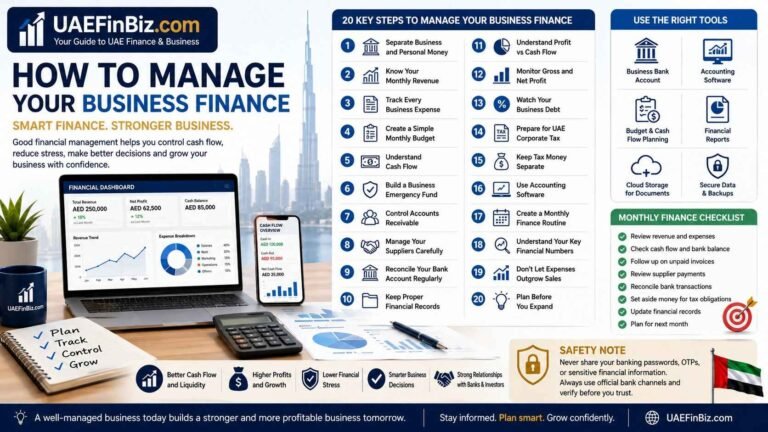
Revenue → Gross profit → Operating expenses → Net profit → Cash flow
These figures are related, but they are not the same.
A company can report a profit while having little cash in its bank account.
For example, if a business sells AED 100,000 worth of products on credit, that AED 100,000 may appear as revenue even though the customer has not yet paid. Meanwhile, the business still has to pay salaries, rent, suppliers, utilities, and other expenses.
This is why UAE SMEs should pay close attention to accounts receivable and cash conversion rather than focusing only on sales.
Business Bank Accounts and Financial Management
A dedicated business bank account provides a clearer separation between company money and personal finances.
For company owners, mixing personal and business transactions can make accounting, financial reporting, expense tracking, and tax compliance more difficult.
A well-managed business account should support the company’s actual operating needs.
Depending on the business, useful banking features may include:
- Local AED transfers
- International transfers
- Salary payments
- Business debit or credit cards
- Online banking
- Multiple-user access
- Payment approvals
- Bulk payments
- Accounting integrations
- Foreign-currency services
- Trade-finance services
The best business banking setup depends on transaction volume and the company’s operating model rather than simply choosing the account with the lowest advertised fee.
Cash Flow Is the Heart of Business Finance
One of the most important concepts for any business owner is cash flow.
Cash flow measures money moving into and out of the company.
A simple example makes the difference clear.
Suppose a company generates AED 500,000 in sales during a period. That sounds positive. But if customers are paying slowly while the company must immediately pay suppliers, salaries, rent, logistics costs, and other expenses, the business can still face a cash shortage.
This is why business owners should regularly prepare cash-flow forecasts.
A basic forecast can show:
| Cash-flow area | What to monitor |
|---|---|
| Sales receipts | When customers are expected to pay |
| Supplier payments | Upcoming bills and payment terms |
| Payroll | Monthly salary obligations |
| Rent | Office, warehouse or retail costs |
| Taxes | Expected tax liabilities |
| Financing | Loan and other repayment obligations |
| Inventory | Cash tied up in stock |
| Emergency reserve | Available liquidity |
A forecast does not need to be complicated. Even a simple rolling 13-week cash-flow forecast can give management a much clearer picture of upcoming pressure points.
Business Finance and UAE Corporate Tax
Corporate Tax is now an important part of financial planning for UAE businesses.
The UAE Corporate Tax framework applies to financial years beginning on or after 1 June 2023. Under the general structure, taxable income up to AED 375,000 is subject to a 0% rate, while taxable income above AED 375,000 is generally subject to 9%, subject to the applicable rules and conditions. Free-zone businesses are also within the Corporate Tax framework, although qualifying Free Zone Persons may receive a 0% rate on qualifying income when the relevant requirements are met.
This makes proper financial records more important than ever.
Corporate Tax should not be treated as something to think about only when the filing deadline approaches. Businesses need reliable accounting records, supporting documents, appropriate classification of income and expenses, and an understanding of their obligations.
The UAE Ministry of Finance states that taxable persons generally calculate Corporate Tax on a self-assessment basis and file their Corporate Tax return within nine months from the end of the relevant tax period.
Businesses should always check their own circumstances because tax treatment can depend on the company’s legal structure, activities, income, tax period, free-zone status, and other factors.
Business Finance and VAT
Value Added Tax can also affect business cash flow.
For businesses registered for VAT, the timing of VAT collection and payment needs to be incorporated into financial planning. VAT collected from customers should not simply be treated as ordinary business income available for spending.
Companies should maintain proper invoices, records, accounting entries, and supporting documentation.
A business that collects VAT but fails to reserve the necessary funds can create an avoidable cash-flow problem when its tax obligations become due.
How Banks Evaluate Business Finance Applications
When a UAE business applies for financing, the bank may assess several aspects of the company’s financial position and operating history.
The exact requirements vary between financial institutions and products, but businesses may be asked for information such as:
- Trade licence
- Corporate documents
- Bank statements
- Financial statements
- Management accounts
- Tax information
- Details of shareholders or owners
- Business activity information
- Existing liabilities
- Revenue information
- Supporting documents for the financing purpose
The bank is essentially trying to understand whether the business is financially capable of meeting its obligations.
This is why maintaining clean financial records can improve the quality of a company’s financing application.
What Improves a Business’s Financial Position?
A business does not need to be large to be financially well managed.
Several practical habits can make a significant difference.
Keep Business and Personal Money Separate
Use company accounts for company expenses and maintain proper records for owner withdrawals and other transactions.
Monitor Receivables
Do not look only at how much customers owe. Track how long invoices have been outstanding and identify customers who consistently pay late.
Negotiate Supplier Terms
If appropriate, negotiating reasonable payment terms with suppliers can reduce pressure on working capital.
Maintain an Emergency Reserve
Businesses face unexpected expenses. A cash reserve can reduce the need for expensive emergency borrowing.
Review Expenses Regularly
Subscriptions, software, rent, logistics, bank fees, insurance, and other recurring costs can gradually consume a significant amount of cash.
Use Accounting Technology
Cloud accounting, automated invoicing, expense management, payroll systems, and bank integrations can reduce manual work and improve financial visibility.
Business Finance Technology in the UAE
Technology is changing how companies manage money.
A modern UAE business can use digital tools for:
- Online invoicing
- Expense tracking
- Payroll
- Accounting
- Cash-flow forecasting
- Payment collection
- Financial reporting
- Bank reconciliation
- Inventory management
- Tax records
- Business analytics
For growing companies, financial technology can also reduce the gap between accounting data and management decisions.
Instead of waiting until the end of the month to discover that expenses increased, a business can use dashboards and automated reports to monitor performance much closer to real time.
Artificial intelligence is also becoming increasingly relevant to financial operations, particularly in areas such as document processing, forecasting, fraud detection, customer support, data analysis, and financial reporting.
However, automation should not replace financial controls. Businesses still need appropriate approval processes, access controls, backups, cybersecurity, and human review.
How to Choose the Right Business Finance Option
Before taking any financing, ask five basic questions:
1. Why do I need the money?
Be specific. Working capital, equipment, expansion, inventory, and debt consolidation can have very different financing requirements.
2. How much do I actually need?
Borrowing more than necessary can increase financing costs and repayment pressure.
3. How quickly can the money be repaid?
Estimate repayment capacity using realistic cash-flow assumptions rather than optimistic sales forecasts.
4. What is the total cost?
Look beyond the headline interest or profit rate and consider fees, charges, security requirements, and other costs.
5. What happens if revenue falls?
A financing structure that works during a strong sales period may become difficult during a slow period.
This final question is often overlooked.
Good business finance is not about finding the maximum amount a company can borrow. It is about finding a sustainable financial structure that supports the business without putting unnecessary pressure on future cash flow.
Common Business Finance Mistakes in the UAE
Some financial mistakes are surprisingly common.
One is treating revenue as cash. A sale is not necessarily money in the bank.
Another is using short-term borrowing to finance long-term business problems. If a company repeatedly needs short-term funding simply to cover operating losses, the underlying business model needs attention.
Some businesses also fail to maintain proper documentation. Missing invoices, unclear expenses, incomplete bank records, and poorly organized financial information can create problems for accounting, tax compliance, financing applications, and management reporting.
Another mistake is choosing finance based only on the monthly payment. A low monthly payment can sometimes result from a longer repayment period and therefore a higher overall financing cost.
Business Finance Checklist for UAE Entrepreneurs
Before making a major financial decision, a business owner should have a clear picture of:
- Current cash balance
- Monthly operating expenses
- Outstanding customer invoices
- Supplier obligations
- Existing loans and financing
- Expected tax liabilities
- Inventory commitments
- Payroll requirements
- Upcoming major purchases
- Expected revenue
- Available emergency reserves
- Financing costs
This simple financial snapshot can make business decisions much more informed.
The Role of Professional Financial Advice
Online information can help business owners understand the basics, but individual financial and tax decisions can become complicated.
A company considering significant borrowing, restructuring, investment, international transactions, tax planning, or major expansion may benefit from advice from appropriately qualified professionals.
The purpose of professional advice is not simply to tell a business owner what to do. It is to help them understand the financial consequences of different options.
For tax matters in particular, businesses should rely on current official UAE guidance and qualified tax professionals when their circumstances require specific advice. The Ministry of Finance itself advises businesses to rely on official Ministry of Finance and Federal Tax Authority publications for Corporate Tax information.
Frequently Asked Questions About Business Finance UAE
What does business finance mean in the UAE?
Business finance covers the money a company uses to start, operate, manage, and grow its business. It includes working capital, loans, trade finance, business banking, cash-flow management, accounting, tax planning, and financial technology.
Can a small business get financing in the UAE?
Potentially, yes. Eligibility depends on the financial institution, business activity, company history, revenue, financial records, credit profile, and the specific financing product. Requirements vary, so businesses should compare products and confirm eligibility directly with licensed financial institutions.
Is business finance only about loans?
No. Business finance includes much more than borrowing. Managing cash flow, controlling expenses, collecting receivables, maintaining reserves, investing in productive assets, managing taxes, and using financial technology are all part of business finance.
Why is cash flow important for a UAE business?
Cash flow shows whether the business has enough actual money available to meet its obligations. A company can be profitable on paper but still experience financial difficulty if customers pay late or expenses have to be paid before revenue is collected.
Does Corporate Tax affect UAE businesses?
Corporate Tax applies to businesses within the scope of the UAE Corporate Tax Law, subject to the relevant rules, exemptions, thresholds, and conditions. The general rate is 0% on taxable income up to AED 375,000 and 9% on taxable income above that amount, with specific rules applying to qualifying Free Zone Persons and other categories.
What is the safest way to check UAE business-finance requirements?
Start with the official website of the relevant government authority, bank, or licensed financial institution. Avoid relying on social-media posts or unofficial websites for tax, banking, financing, or regulatory decisions.
Final Thoughts
Business finance in the UAE is ultimately about making the company’s money work properly. Financing can help a business purchase inventory, manage working capital, invest in equipment, expand into new markets, and take advantage of growth opportunities. But borrowing is only one part of the equation.
Strong businesses usually build their financial foundation around accurate records, disciplined cash-flow management, sensible spending, appropriate financing, tax compliance, and good financial technology.
For UAE entrepreneurs, the goal should not simply be to increase revenue. It should be to build a business that can generate profit, preserve cash, manage risk, meet its obligations, and grow sustainably.
That is the practical side of business finance, and it is the kind of information uaefinbiz.com aims to make easier to understand for entrepreneurs, companies, professionals, and anyone navigating the UAE’s finance and business environment.