
UAE Finance Updates 2026 – Latest Banking, Tax & Financial Changes
The UAE finance sector is moving quickly in 2026, with important developments across banking, payments, taxation, financial technology, business finance, and regulatory policy. From the launch of Jaywan, the UAE’s national card scheme, to new Central Bank initiatives and continuing tax compliance requirements, these changes can directly affect individuals, businesses, investors, and financial professionals.
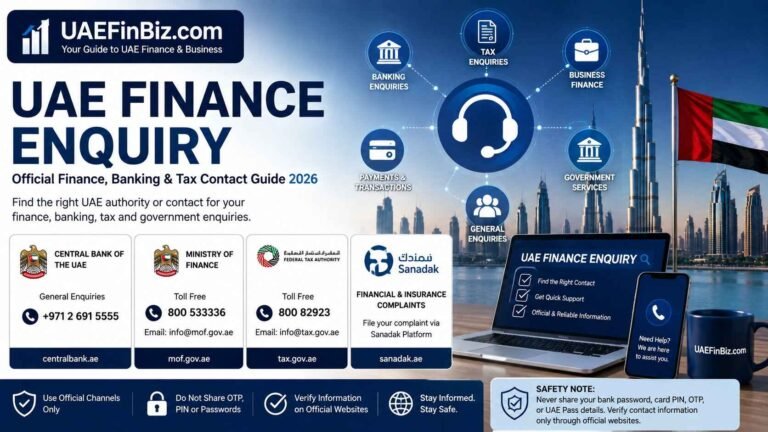
Safety Note: For financial, banking, and tax matters, always verify the latest information through official UAE authorities before making payments, sharing financial information, or acting on a regulatory update. For banking and monetary matters, check the Central Bank of the UAE; for tax matters, use the Federal Tax Authority.
UAE Finance Updates: What Is Changing in 2026?
The UAE financial landscape is becoming more digital, connected, and closely regulated. Current developments cover several areas that matter to everyday consumers and businesses, including digital payments, banking stability, corporate tax, VAT compliance, open finance, and financial inclusion.
For readers searching for UAE finance updates, the key point is that financial changes are not limited to banks. Government tax policies, payment infrastructure, fintech initiatives, business regulations, and Central Bank decisions can all influence how money is managed in the UAE.
The Central Bank of the UAE regularly publishes monetary, banking, and financial-market reports, while the Federal Tax Authority continues to publish tax announcements and compliance updates.
Jaywan: A Major UAE Payments Update
One of the most significant recent developments is Jaywan, the UAE’s first national card scheme.
The Central Bank reported that Jaywan was inaugurated on 20 July 2026. The national payment scheme is part of the UAE’s wider effort to strengthen domestic payment infrastructure and develop a more integrated digital financial ecosystem.
For consumers and businesses, developments such as Jaywan are important because payment systems influence how cards, merchants, banks, and digital transactions work together.
As the national payment ecosystem develops, users should expect greater attention to domestic payment capabilities, digital transactions, security, and financial technology.
Central Bank Base Rate Remains at 3.65%
Interest rates remain an important part of UAE finance updates because they can influence borrowing costs, business financing, deposits, and other financial products.
On 17 June 2026, the Central Bank of the UAE announced that it was maintaining its Base Rate at 3.65%.
The Base Rate does not mean every UAE loan or bank product carries exactly the same rate. Banks determine the pricing of individual products based on factors such as the product, customer profile, market conditions, and applicable terms.
For businesses, however, changes in the broader interest-rate environment can affect financing decisions, working capital costs, expansion plans, and cash-flow management.
UAE Banking Sector Continues to Focus on Resilience
Financial stability remains a major priority for UAE regulators.
Earlier in 2026, the Central Bank announced a proactive financial-institution resilience package backed by its assets of AED 1 trillion. The initiative was presented as part of efforts to strengthen the resilience of financial institutions and the UAE banking system.
This is particularly relevant for businesses and customers because a stable banking system supports lending, payments, deposits, investment activity, and everyday financial transactions.
The Central Bank also continues to publish monetary and banking statistics, financial stability information, and quarterly economic reports, giving businesses and financial professionals more visibility into developments across the UAE financial system.
UAE Corporate Tax Remains a Key Business Finance Issue
Corporate tax continues to be one of the most important subjects for businesses searching for UAE finance updates.
According to the UAE Government’s current corporate tax information, the standard UAE Corporate Tax structure includes 0% on taxable income up to AED 375,000 and 9% on taxable income above AED 375,000, subject to the applicable rules and exemptions.
This means businesses should not look at corporate tax simply as a payment obligation. Proper accounting records, tax registration where required, documentation, financial reporting, and timely filing are all part of responsible business finance management.
Companies should also distinguish between revenue, taxable income, accounting profit, and other financial measures rather than assuming that a company’s total sales automatically represent its taxable income.
VAT Compliance Continues to Matter
VAT remains another major part of the UAE finance landscape.
The Federal Tax Authority currently provides VAT services, calculators, announcements, and tax guidance through its official platform. The FTA’s 2026 announcements include VAT return deadlines and other compliance information.
For businesses registered for VAT, keeping accurate invoices and accounting records is essential. Missing a filing deadline or misunderstanding a tax obligation can create unnecessary compliance problems.
The FTA also continues to improve its digital services, making it increasingly important for businesses to monitor official announcements rather than relying on outdated information found elsewhere online.
FTA Reports Strong Tax Administration Activity
The Federal Tax Authority’s latest published information shows continued growth in tax administration activity.
Its 2025 annual report, highlighted in 2026 updates, reported AED 46 billion in VAT and excise tax revenues, while tax-registration transactions increased to 1.7 million, up 20%.
These figures demonstrate how important the tax ecosystem has become to the UAE’s broader financial infrastructure.
For companies, the practical lesson is straightforward: tax compliance should be built into normal financial management instead of treated as a last-minute administrative task.
Open Finance Is Expanding
Another important development is the UAE’s move toward open finance.
In June 2026, the Central Bank announced progress through Aperta, described as a secure cross-border open finance project.
Open finance can potentially create new ways for financial institutions and authorised providers to securely exchange financial information and deliver financial services.
The important word is secure. Financial data should never be shared simply because a website or application claims to offer a financial service. Customers should verify providers, understand permissions, and use official channels.
Digital Banking Continues to Grow
Digital banking remains a major direction for UAE financial services.
The Central Bank, the Federal Authority for Identity, Citizenship, Customs and Port Security, and Abu Dhabi Commercial Bank announced a digital bank-account opening initiative through the Tourist Identity programme in April 2026.
This reflects the UAE’s wider move toward digital-first financial services, where identity verification, mobile applications, online onboarding, and electronic payments increasingly form part of the customer journey.
For consumers, digital convenience is valuable, but account security should remain a priority.
Financial Inclusion Is Still a Priority
The UAE’s financial sector is also focusing on financial inclusion.
In June 2026, the Central Bank announced a strategic partnership with the World Bank Group aimed at strengthening financial inclusion.
Financial inclusion means improving access to suitable financial services for people and businesses that may face barriers to traditional financial products.
This area is increasingly connected with digital payments, fintech, banking access, financial education, and secure digital identity systems.
What UAE Finance Updates Mean for Businesses
For UAE businesses, financial news is not just something to read. Regulatory and banking developments can affect daily operations.
A business owner should regularly review:
- Corporate tax obligations and filing requirements
- VAT registration and return deadlines
- Business bank-account requirements
- Loan and financing costs
- Cash-flow requirements
- Payment-system developments
- Digital banking security
- Accounting and financial records
- Changes announced by UAE regulators
The goal is not to react to every headline. It is to identify the updates that can actually affect the company’s finances.
What Consumers Should Watch
Individuals should also pay attention to UAE finance updates, particularly when using banking and digital-payment services.
Important areas include card-payment developments, banking fees, interest rates, digital wallets, account security, fraud prevention, and changes to financial services.
Never provide your banking password, PIN, one-time password, or full card security information to someone contacting you unexpectedly. A legitimate-looking message does not automatically make a financial request legitimate.
Where to Check Authentic UAE Finance Updates
The safest way to follow financial developments is to start with the official authority responsible for the subject.
For monetary policy, banking regulation, payment systems, and financial-sector developments, the Central Bank of the UAE is the primary source. Its news and publications section provides current announcements, reports, and financial-sector information.
Check Central Bank of the UAE updates
For VAT, excise tax, corporate tax administration, registration, filing, and related compliance matters, the Federal Tax Authority should be checked directly.
Check Federal Tax Authority updates
UAE Finance Updates 2026: The Bigger Picture
The UAE financial sector in 2026 is developing around several connected themes: stronger financial resilience, digital payments, open finance, digital banking, tax compliance, financial inclusion, and continued regulatory modernization.
The launch of Jaywan, continued Central Bank policy announcements, open-finance developments, and ongoing FTA tax administration activity all point toward a financial ecosystem that is becoming increasingly digital and structured.
For residents, investors, entrepreneurs, and companies, staying informed is becoming part of good financial management.
Frequently Asked Questions About UAE Finance Updates
What are the latest UAE finance updates in 2026?
Major developments include the launch of Jaywan, the Central Bank’s 3.65% Base Rate decision in June 2026, continued financial-sector resilience initiatives, progress on open finance, digital banking developments, and ongoing tax-compliance updates from the Federal Tax Authority.
What is the current UAE Corporate Tax rate?
The UAE’s current structure provides a 0% rate on taxable income up to AED 375,000 and 9% on taxable income above AED 375,000, subject to applicable rules.
What is Jaywan?
Jaywan is the UAE’s first national card scheme. It was inaugurated in July 2026 as part of the country’s development of its domestic payment infrastructure.
Where can I verify UAE financial news?
For banking and monetary developments, check the Central Bank of the UAE. For tax-related information, check the Federal Tax Authority. These official sources are preferable to relying solely on social media posts, forwarded messages, or unofficial websites.
Why should businesses follow UAE finance updates?
Financial and regulatory changes can affect tax compliance, banking, borrowing costs, payments, accounting, and business planning. Monitoring official updates helps businesses make decisions using current information.
Final Thoughts
UAE finance updates in 2026 are increasingly connected to everyday money management and business decisions. From national payment infrastructure and digital banking to corporate tax, VAT compliance, interest rates, and financial-sector resilience, the UAE is continuing to build a more digitally connected financial ecosystem.
The most reliable approach is simple: follow official announcements, verify important financial information before acting, and review changes that directly affect your personal or business finances. For readers using UAEFinbiz.com as a practical UAE information resource, keeping up with verified finance updates can make complex financial developments much easier to understand and act on responsibly.