
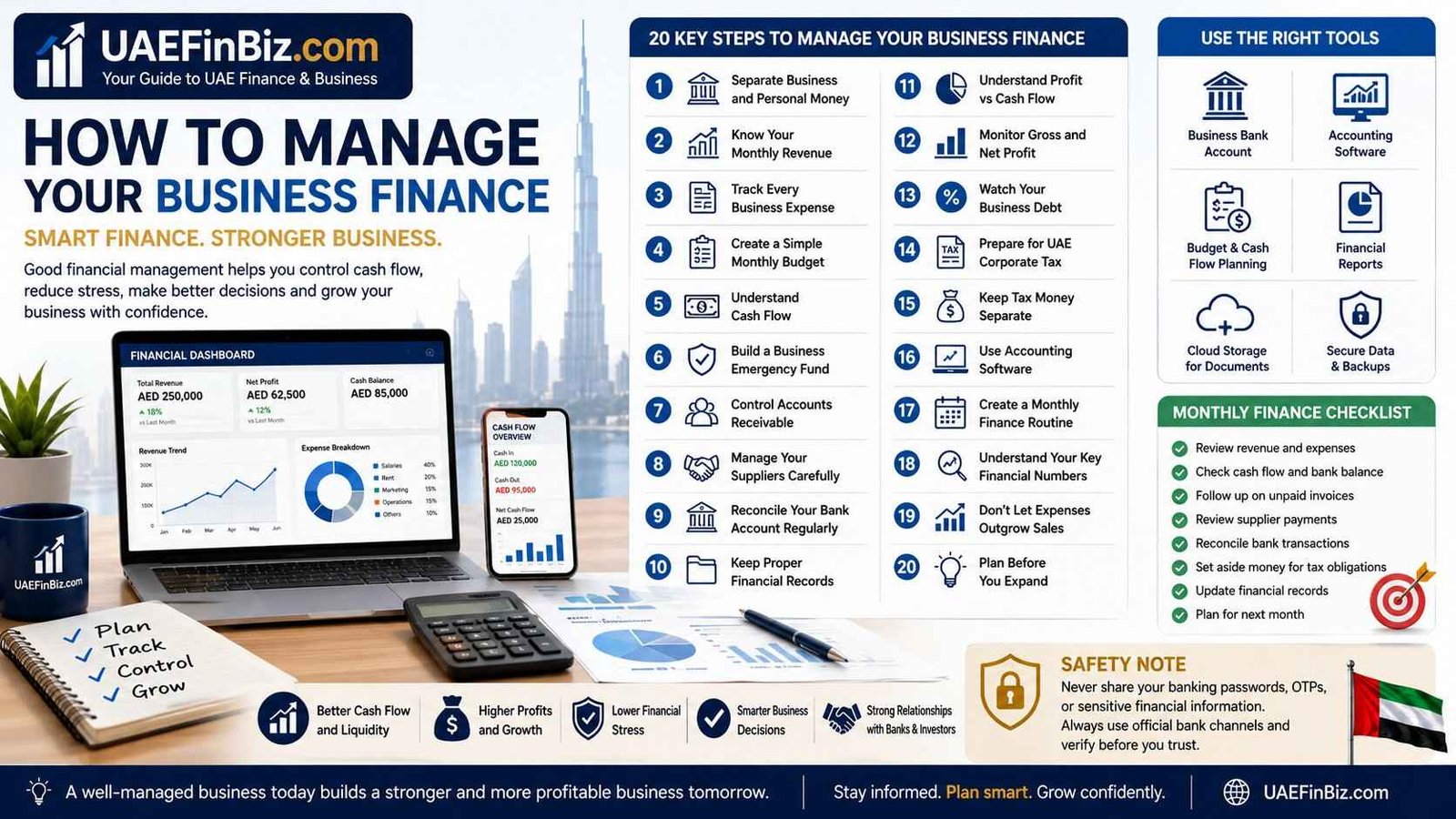
How to Manage Your Business Finance in the UAE – Complete Guide
Running a business can keep you busy from morning until night, but there is one part of the business you cannot afford to leave until the end of the month: the money. You may be getting customers, sending invoices and making sales, yet still wonder where the cash actually went. This is especially common with small businesses, online companies and growing startups where the owner is handling everything at once. Managing your business finance is really about knowing what is coming in, what is going out, what you owe, what customers owe you, and how much money the business can safely spend.
In the UAE, good financial management also means keeping proper records and understanding your tax and banking responsibilities. The Federal Tax Authority says businesses should maintain financial statements and records such as transactions, assets, liabilities, stock, bank statements, invoices and financing documents where applicable.
Safety Note: Do not share your business banking passwords, OTPs, card details or account credentials with accountants, agents or unknown third parties. For tax records, Corporate Tax requirements and official UAE tax services, use the Federal Tax Authority (FTA) and its official EmaraTax platform. Federal Tax Authority – Official Website
What Does Managing Business Finance Actually Mean?
Managing business finance does not simply mean checking your bank balance.
It means having a system for controlling the financial side of your company so you can make informed decisions.
A well-managed business should know:
- How much revenue it generates
- How much it spends
- Which expenses are necessary
- How much customers owe
- How much the business owes suppliers
- How much cash is available
- How much profit it is actually making
- How much tax may be payable
- Whether it can afford new employees or equipment
- Whether it can safely take on financing
You do not need to be a financial expert to start doing this properly. You need accurate records and a routine that you actually follow.
Why Business Finance Management Matters in the UAE
A business can have strong sales and still experience financial problems.
Imagine a company making AED 100,000 in sales but spending AED 85,000 on inventory, salaries, advertising, rent, software, logistics and other costs. If customers are taking 60 days to pay invoices while suppliers need payment within 15 days, the company can experience a cash-flow problem even though its sales look impressive.
This is why profit and cash flow are not the same thing.
Managing business finance helps you see the difference before it becomes a serious problem.
Step 1: Separate Business and Personal Money
One of the simplest improvements an owner can make is separating business money from personal money.
Use a dedicated business bank account for:
- Customer payments
- Supplier payments
- Business subscriptions
- Advertising
- Payroll
- Government fees
- Business financing
- Other company expenses
Avoid using the same account for groceries, family expenses, holidays and business purchases.
A clean separation makes your accounts easier to understand and creates a much clearer financial record.
It is also easier for an accountant to identify genuine business income and expenses when personal transactions are not mixed into the same account.
Step 2: Know Your Monthly Revenue
Do not judge the health of your business by looking at your bank balance.
Track your revenue every month.
For example:
| Month | Sales |
|---|---|
| January | AED 75,000 |
| February | AED 82,000 |
| March | AED 91,000 |
| April | AED 86,000 |
Looking at several months together gives you a better picture than looking at one good month.
You can also compare revenue by:
- Product
- Service
- Customer
- Sales channel
- Location
- Online vs offline sales
This helps you identify where your actual money is being generated.
Step 3: Track Every Business Expense
Small expenses have a habit of becoming large expenses when nobody tracks them.
Your business-finance system should record costs such as:
- Office rent
- Salaries
- Freelancers
- Advertising
- Software subscriptions
- Website hosting
- Telecom services
- Transportation
- Inventory
- Packaging
- Shipping
- Professional fees
- Bank charges
- Insurance
- Government fees
- Equipment
- Loan or financing costs
The FTA’s Corporate Tax guidance specifically identifies records such as bank statements, loan or financing documentation, sales and purchase ledgers, invoices, order records and delivery notes as examples of business documentation that may need to be maintained.
Step 4: Create a Simple Monthly Budget
A budget does not have to be complicated.
Start with three categories:
Expected income
How much money do you expect to receive?
Fixed expenses
What costs are relatively predictable?
Examples include rent, salaries and software subscriptions.
Variable expenses
What changes depending on sales?
Examples include advertising, shipping, inventory and payment processing.
Then calculate:
Expected income − expected expenses = expected cash position
Review this every month.
If expenses are consistently rising faster than revenue, you have a warning sign that needs attention.
Step 5: Understand Cash Flow
Cash flow is one of the most important parts of business finance management.
A simple cash-flow calculation is:
Opening cash + money received − money paid = closing cash
Suppose your business starts the month with AED 50,000.
You receive AED 70,000 from customers and pay AED 85,000 in expenses.
Your closing cash would be:
AED 50,000 + AED 70,000 − AED 85,000 = AED 35,000
The business may still be profitable on paper, but the available cash has fallen.
That difference is important when deciding whether you can afford a new employee, equipment, office or marketing campaign.
Step 6: Build a Business Emergency Fund
Businesses should not operate with every dirham already committed.
Unexpected costs can appear at any time:
- Equipment failure
- Customer payment delays
- Higher supplier costs
- Emergency repairs
- Legal expenses
- Unexpected government fees
- Lower seasonal sales
- Technology problems
An emergency reserve gives the business breathing room.
The appropriate amount depends on your industry, fixed expenses and risk level. A company with high monthly payroll needs a different cash reserve from a small solo consultancy.
Step 7: Control Accounts Receivable
If you sell on credit, keep track of every unpaid invoice.
A simple receivables report might look like:
| Customer | Invoice | Amount | Due Date | Status |
|---|---|---|---|---|
| Customer A | INV-101 | AED 8,000 | 10 Aug | Paid |
| Customer B | INV-102 | AED 12,000 | 15 Aug | Due |
| Customer C | INV-103 | AED 6,500 | 20 Aug | Overdue |
This prevents unpaid invoices from disappearing into your accounting system.
Send invoices promptly and establish clear payment terms.
If a customer repeatedly pays late, consider whether the relationship is creating a cash-flow problem for your company.
Step 8: Manage Your Suppliers Carefully
The other side of cash flow is accounts payable.
Track:
- Supplier name
- Invoice amount
- Due date
- Payment status
- Payment method
- Any discounts
- Outstanding balance
Do not pay every bill immediately simply because money is available.
At the same time, do not deliberately delay legitimate payments without understanding the consequences.
The goal is controlled cash flow.
Step 9: Reconcile Your Bank Account Regularly
Your accounting records and bank statement should tell the same story.
Bank reconciliation helps identify:
- Missing transactions
- Duplicate payments
- Bank charges
- Unrecorded receipts
- Incorrect entries
- Failed payments
- Unauthorised transactions
For a small business, a monthly reconciliation may be a practical starting point.
Businesses with large transaction volumes may need more frequent checks.
Step 10: Keep Proper Financial Records
Good financial management becomes much easier when your records are organised.
Maintain records for:
- Sales
- Purchases
- Expenses
- Bank transactions
- Assets
- Liabilities
- Inventory
- Financing
- Invoices
- Receipts
- Payroll
- Tax-related documents
The FTA explains that the records maintained should generally allow taxable income to be readily determined and notes that the required information can vary according to the nature and complexity of the business.
Electronic records can also be used where permitted; the FTA guidance notes that documents such as paper receipts may be scanned and stored electronically.
Step 11: Understand Profit vs Cash Flow
This is one of the most important concepts for any business owner.
Profit
Profit is broadly what remains after accounting for relevant income and expenses.
Cash Flow
Cash flow tracks the actual movement of money into and out of the business.
You can have:
Profit but poor cash flow
For example, you make AED 50,000 in sales but customers will not pay for 60 days.
Or:
Cash but low profit
You receive a large customer advance but have significant costs still coming later.
Looking at both numbers gives you a much better understanding of your company’s financial position.
Step 12: Monitor Your Gross and Net Profit
Revenue alone does not tell you whether your business is healthy.
Suppose an online store generates AED 200,000 in sales.
Its direct product costs are AED 100,000.
Gross profit:
AED 200,000 − AED 100,000 = AED 100,000
But then you still have:
- Salaries
- Advertising
- Rent
- Technology
- Shipping
- Professional fees
- Bank charges
- Other operating costs
Your final profit will therefore be lower.
Track both gross profit and net profit.
Step 13: Watch Your Business Debt
Business financing can help a company grow, but debt needs to be managed carefully.
Before taking financing, calculate:
- Total amount borrowed
- Interest or profit cost, depending on the product
- Monthly repayment
- Total repayment
- Financing period
- Early-settlement conditions
- Security or guarantees
- Effect on monthly cash flow
Never choose financing simply because the monthly payment looks affordable.
Calculate the total cost.
Also make sure the financing is being used for something that genuinely supports the business rather than covering recurring losses without a recovery plan.
Step 14: Prepare for UAE Corporate Tax
Tax should be part of your financial planning rather than something you think about only when a filing deadline approaches.
The UAE Corporate Tax framework applies to businesses within its scope, and the FTA provides guidance on financial statements, accounting methods and record keeping.
The FTA’s current guidance states that eligible taxpayers with revenue not exceeding AED 3 million for the relevant tax period may use the cash basis of accounting, subject to the applicable rules.
Do not assume that a business qualifies simply because its revenue is below a particular figure. Tax treatment depends on the applicable legislation and the taxpayer’s circumstances.
For tax decisions, check the latest FTA guidance or speak with a qualified tax professional.
Step 15: Keep Tax Money Separate
One practical approach is to avoid treating all money received from customers as money available for spending.
Depending on your business’s tax obligations, set aside an appropriate amount for expected tax liabilities.
This reduces the risk of reaching a filing or payment deadline and discovering that the money has already been spent on business operations.
A separate savings account or internal accounting reserve can make this easier to monitor.
Step 16: Use Accounting Software
You do not necessarily need an expensive accounting system.
The right software should make it easier to:
- Record income
- Record expenses
- Create invoices
- Track receivables
- Track suppliers
- Reconcile transactions
- Monitor cash flow
- Produce reports
- Organise financial records
For a small business, simplicity is often more valuable than having dozens of features nobody uses.
As the business grows, you can move to more advanced accounting and enterprise systems.
Step 17: Create a Monthly Finance Routine
A simple routine can make a huge difference.
Every Week
Check:
- Bank balance
- Incoming payments
- Urgent bills
- Overdue invoices
- Unusual transactions
Every Month
Review:
- Revenue
- Expenses
- Gross profit
- Net profit
- Cash flow
- Receivables
- Payables
- Bank reconciliation
Every Quarter
Look at:
- Revenue growth
- Expense growth
- Profit margins
- Customer concentration
- Debt
- Cash reserves
- Tax position
- Upcoming major expenses
Every Year
Review:
- Business performance
- Financial statements
- Tax obligations
- Financing
- Insurance
- Major contracts
- Business goals
- Next year’s budget
Step 18: Understand Your Key Financial Numbers
You do not need to monitor hundreds of metrics.
Start with a few important numbers.
Revenue
How much money is the business generating?
Gross Margin
How much remains after direct costs?
Net Profit Margin
How much of your revenue becomes profit after relevant expenses?
Operating Expenses
How much does it cost to run the business?
Accounts Receivable
How much money do customers still owe?
Accounts Payable
How much does the business owe suppliers?
Cash Balance
How much cash is currently available?
Burn Rate
How quickly is the company spending cash?
These numbers can quickly tell you whether the business is moving in the right direction.
Step 19: Don’t Let Business Expenses Grow Faster Than Sales
Growth can create a dangerous trap.
A business earns more money, so the owner hires more people, moves into a bigger office, increases advertising and subscribes to more software.
Revenue increases by 15%, but expenses increase by 30%.
The company looks bigger but becomes financially weaker.
Before adding a recurring expense, ask:
Will this expense generate enough additional revenue, reduce costs, or materially improve the business?
If the answer is unclear, consider testing the idea on a smaller scale first.
Step 20: Manage Inventory Carefully
For product-based businesses, inventory can consume a large amount of cash.
Too much inventory means money is sitting on shelves.
Too little inventory can lead to missed sales.
Track:
- Fast-moving products
- Slow-moving products
- Stock value
- Reorder levels
- Supplier lead times
- Damaged goods
- Unsold inventory
Inventory management is therefore part of financial management, not just warehouse management.
Step 21: Be Careful With Business Banking
Your business bank account is the central point through which much of your company’s money moves.
Protect it by:
- Using strong passwords
- Enabling multi-factor authentication where available
- Giving employees only the access they need
- Reviewing transactions regularly
- Setting transaction alerts
- Verifying payment requests
- Avoiding unknown links
- Keeping banking information confidential
The CBUAE’s regulatory framework includes customer due diligence requirements for financial institutions, including understanding the nature and purpose of business accounts and identifying beneficial owners.
This is one reason banks may ask businesses detailed questions about ownership, activities and expected transactions.
Step 22: Don’t Mix Accounting With Guesswork
One common mistake is making financial decisions based on how the business “feels.”
A busy month does not automatically mean a profitable month.
A quiet month does not automatically mean the company is failing.
Use actual numbers.
For example:
Revenue: AED 150,000
Direct costs: AED 65,000
Operating expenses: AED 55,000
Approximate operating profit: AED 30,000
Now compare that with the previous month.
Numbers reveal trends that intuition can miss.
Step 23: Build a Simple Financial Dashboard
You can create a one-page monthly dashboard showing:
| Metric | Current Month | Previous Month |
|---|---|---|
| Revenue | AED 150,000 | AED 138,000 |
| Expenses | AED 120,000 | AED 113,000 |
| Net Profit | AED 30,000 | AED 25,000 |
| Cash Balance | AED 85,000 | AED 72,000 |
| Receivables | AED 42,000 | AED 39,000 |
| Payables | AED 27,000 | AED 31,000 |
This takes only a few minutes to review once your accounting records are organised.
More importantly, it gives the owner a quick answer to the question:
“How is my business actually doing?”
Step 24: Know When to Hire an Accountant
You can manage basic financial tracking yourself, especially when the business is small.
But professional help becomes increasingly valuable when you have:
- Multiple employees
- Large transaction volumes
- Complex ownership
- International transactions
- Significant inventory
- Financing
- Multiple business activities
- Corporate Tax obligations
- Rapid growth
- Complicated accounting requirements
An accountant should not simply prepare numbers after the fact.
A good finance professional can also help you understand what the numbers mean.
Step 25: Plan Before You Expand
Before opening another branch, hiring several employees, buying expensive equipment or entering a new market, create a financial projection.
Calculate:
Expected additional revenue
minus
Additional operating costs
minus
Additional financing costs
equals
Expected additional contribution
Then test what happens if sales are lower than expected.
For example:
Best case: Sales +25%
Expected case: Sales +10%
Worst case: Sales −10%
If the business cannot survive the downside scenario, expansion may need to be delayed or redesigned.
A Simple Business Finance System for UAE SMEs
If you want a straightforward system, use this five-part structure:
1. Business Bank Account
Keep commercial money separate.
2. Accounting System
Record every sale and expense.
3. Monthly Budget
Decide what you can afford before spending.
4. Cash-Flow Forecast
Know when money will enter and leave.
5. Monthly Financial Review
Compare actual performance with your plan.
This simple system can work for many small businesses before they need a much more sophisticated finance department.
Common Business Finance Mistakes
Spending Based on Revenue
High sales do not necessarily mean high profit.
Ignoring Cash Flow
A profitable company can still run out of cash.
Mixing Personal and Business Expenses
This makes financial records unnecessarily difficult to manage.
Forgetting Small Expenses
Subscriptions and small recurring charges can add up quickly.
Not Following Up on Unpaid Invoices
Revenue is not useful to your cash flow until customers actually pay.
Taking Too Much Debt
Financing should support the business, not overwhelm it.
Waiting Until Tax Time
Tax and accounting records should be maintained throughout the year.
Keeping Everything in Spreadsheets Forever
Spreadsheets can be useful, but growing businesses may eventually need dedicated accounting software.
Business Finance Checklist
Before the end of each month, ask yourself:
- Did I record all sales?
- Did I record all expenses?
- Did I reconcile the bank account?
- Which customers still owe money?
- Which supplier payments are due?
- What is my current cash balance?
- What is my actual profit?
- Are expenses growing faster than revenue?
- Do I have enough cash for upcoming commitments?
- Have I set aside money for expected tax obligations?
- Are all important financial documents stored safely?
- Do I need to change next month’s budget?
If you can answer these questions every month, you already have a much stronger financial-control system than many small businesses.
Frequently Asked Questions
What is the best way to manage business finance?
Start by separating personal and business money, recording every transaction, preparing a monthly budget, monitoring cash flow, following up on unpaid invoices and reviewing your financial performance every month.
How often should I review my business finances?
Small businesses should ideally monitor cash and important transactions regularly and conduct a more complete financial review at least once a month.
What is the difference between business revenue and profit?
Revenue is the money generated from sales or business activities. Profit is what remains after applicable costs and expenses are accounted for.
Why is cash flow important for a business?
Cash flow shows when money actually enters and leaves the business. A company can be profitable on paper but still experience difficulty paying bills if customers pay late or large expenses arrive before expected receipts.
Should I keep a separate business bank account?
For a company, keeping business finances separate from personal spending is a practical way to maintain cleaner records and understand the company’s actual financial position.
How long should UAE businesses keep financial records?
The exact record-retention requirements depend on the applicable UAE tax and legal rules and the type of business. Businesses should follow current FTA requirements and maintain the records needed to support their tax position. The FTA’s Corporate Tax guidance explains the types of financial and supporting records businesses may need to maintain.
Can a small business manage its own finances?
Yes. A small business can handle basic bookkeeping, budgeting and cash-flow tracking internally. However, professional accounting or tax advice can become important as transactions and regulatory requirements become more complicated.
When should a business consider financing?
Financing can make sense when it supports a clear business purpose and the company can comfortably manage repayments. Always calculate the total financing cost and its effect on future cash flow before borrowing.
Final Thoughts
Learning how to manage your business finance is not about becoming an accountant overnight. It is about building a habit of knowing what your business earns, what it spends, what customers owe, what you owe others and how much cash is available for the next few months.
For UAE businesses, financial management also needs to sit alongside proper record keeping, banking controls and applicable Corporate Tax obligations. The FTA specifically expects businesses within the relevant tax framework to maintain appropriate financial and supporting records, while the UAE’s financial regulatory framework continues to place importance on responsible financial services and SME access.
The simplest approach is often the most effective: record everything, separate business and personal money, watch cash flow, control expenses, plan for tax, review your numbers every month and make growth decisions based on actual figures rather than assumptions.
For more practical UAE business and finance guides, UAEFinBiz.com focuses on helping entrepreneurs understand the financial side of running a business in the UAE.